To Exercise Virtue

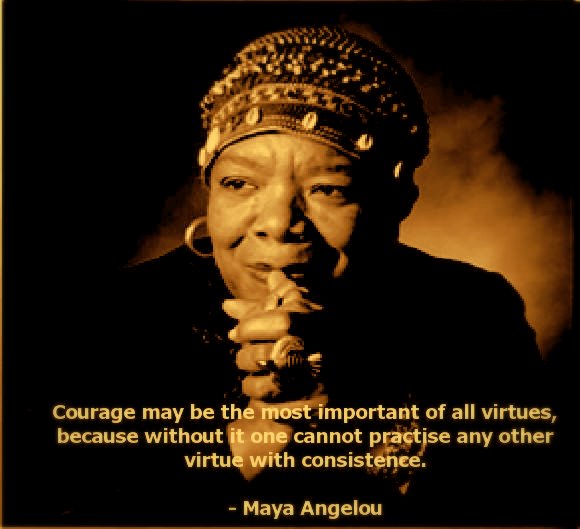
‘Courage is the most important of all the virtues because without it you can’t practice any other virtue consistently.’ -Maya Angelou

I’m thinking a lot about this quote and the idea it contains today.

Last night we elected a man to lead our country who I find to be dangerous. And I’m a white, middle class male. I can’t imagine the fear that my darker skinned brothers and sisters are feeling right now. I identify with them and I agree with them and I vote with them, but I am disciplined in acknowledging always that I am not in their shoes. I cannot have their perspective, even if I empathize with it. I am not the father of little girls nor am I a woman. I’m a native English speaking American and don’t have to fear being rounded up. I advocate for the disabled, both professionally and personally and I’m not them, watching a man openly mock an actual person with a disability, bullying him while doing his job from the podium with flags flying and crowds cheering and guffawing. I’m an advocate, but I’m protected.

I’m from the disaffected, largely white area of the country that would appear to have given the Presidency to Donald Trump. I know that the people that voted for him see something other than a dangerous, white supremacist, misogynistic monster. From my angle I’m afraid that that thing they saw allowed them to think they were supporting someone of virtue. Someone who would prioritize them without hurting others. I fear that they similarly can’t see what this feels like to fellow, hard working Americans with skin darker than theirs. Or the hard working immigrant families who’ve sacrificed whole lives, whole histories and all social standing to come to the place where hope lived only to find it lead by a man threatening to deport, insisting on building a wall and enthusiastically able to belittle and dismiss the sacrifice of families who’ve lost loved ones in defense of our highest ideals.

I don’t have any idea what I can do but stand up and try to find a sliver of light in the dark where I can try to send love through. It’s hard to listen when you are afraid. I am afraid. But it’s incredibly important to listen. I will try. I’m pretty sure I’ll fail a lot of the time, but i will keep trying.

What I do see is there is a lot of anger. There is a lot of fear. The air has been thick with it for years. My instincts in this moment are awful. I want to scream. I want to yell and lash out and blanket the land in judgment. It would feel good to do that. The fights that would ensue would make me feel like I was doing something. But I’d be working against the solutions we need. The fact is that this is a time that demands virtue. You can’t defeat the dark without light. You can’t address fear with fear. Anger will not go away with louder anger.

Patience. Love. Understanding. Compassion. Empathy.

These are the virtues we are lacking. There are real world problems that require real world answers. Yes. But if we can’t hear each other, if we can’t understand and empathize with the real fears than we can’t even begin the difficult conversations we need to have. We can’t ever learn to understand why something so confounding, how something so terrifying ever could have happened. I’m scared, I truly am. For me to overcome it’s going to take courage. It’s going to take courage to be patient. To listen. To try to reseed humanity, whatever tiny little portion of it I can effect with love.

There’s work to do. We must shine light into darkness. We must stay curious. We must seek out hate and counter it with love. We must find fear and meet it with empathy. We must meet anger head on and do whatever we can to show people compassion and love.

We must have courage and exercise our virtues. This is a time for our better angels to reveal themselves.

The Problem with the ‘Good Schools’

High School ClassroomWe live where we live for a lot of reasons. We feel its a good place to grow up for our kids. A big reason for this, the biggest reason we are here, is the schools. We moved here for the schools. It’s a common refrain.We’re starting to meet the other parents of kids who will be in Charlie’s kindergarten class and so many of them mention the schools as a part of why they are here. There was a state wide ranking that came out around the time we moved here declaring our school the top rated public school in the state.

We can’t afford private schools and neither my wife nor I are interested in them. We were public school kids and we wanted the same for our kids. We wanted them to have a real connection to the place they grew up. Besides public schools fit better with our politics as well. But I can’t help being a little uncomfortable with the idea of ‘moving here for the schools.’ I can’t help but think there’s some coded message in the phrase, some coded history that reflects how we’ve gotten here.

My town is 85% white, 10% Asian and just over 1% African American. These numbers are from the 2010 census. We have a train station that allows one to easily access commuter lines to NYC. Broadly speaking New Jersey is a diverse populace, particularly as you approach the city. So why this largely homogenous population? I have some ideas.

The great migration of African American’s from the south to cities of the northeast and Midwest made northerners confront the realities of a diversifying population. We white folks didn’t really handle it all that well. What many of my contemporaries now see as an organic, self segregating impulse that has left many communities largely homogenous was in fact anything but organic in how it came to be.

Many of you will surely recognize at least some of what I’m saying. Perhaps your history makes you aware of the great migration. Perhaps your history makes you aware that diversity can be more an economic issue than a racial one. Perhaps you can see that the community you live in, the one you moved to, perhaps for the ‘good schools’, is largely homogenous but feel that this being a free country that the whiteness of your town is coincidence more than design. If you think this last thing you might be right. Surely there are some communities that this is true of and those communities have other issues. Also, they are unicorns. Generally speaking the communities we live in are homogenous by intent if not design.

When African American families moved to the north they met opportunity to be sure. They met successes that would have been unthinkable in some areas of the rural south they left. They met new challenges and new problems as well. One of those being that despite the north being on the side of the angels in the war, it didn’t mean their was any less racial animus here. It didn’t mean that there was a smoother integration. In fact, it turned out, so much of the racial tolerance many expected was completely absent and there was new, sophisticated ways in which they were experiencing racism. Subtle ways that kept them struggling no matter how hard they tried. Wage deflation, employment discrimination, poor funding of schools, legal bias and housing discrimination.

Housing discrimination was rampant. If you were a young black professional with a family you were shown the ‘black’ parts of town. You were refused tenancy in ‘white’ areas, at least the desirable ones. The ones where you were barred from as your presence would ‘bring down property values’. Steering people to one place based on a perceived undesirability, having brown skin in this case, was how we ghettoized the African American’s who moved north for a better life. So the young, black child of that young black doctor couldn’t go to the schools where the young white kids of the young white doctor went, where they had other young professionals and tax bases were strong and schools well funded. The ceiling of achievement was thus lowered to meet their blackness. Furthermore those young, bright, possibly world changing young kids segregated into ‘black’ areas were losing the value of home ownership that was growing for their white counterparts since there was the burgeoning reality that the areas where African Americans lived were losing value as they could only sell to ‘blacks’, who were increasingly poorly educated by underfunded schools.

For a generation or two black businesses working with largely black clientele may have thrived, but the communities were crumbling under increasing financial pressures being put upon them to relocate as their neighboring ‘white’ neighborhoods, growing richer from generation to generation needed to co-opt more property to keep the growth going. Gentrification is a beautiful and euphonious word considering how destructive a force it has been in so many communities of color over the years.

White folks in white neighborhoods started to see themselves as more capable, more worthy and ultimately more valuable. Over time the system reinforced these views and before long what was simple racism could now be seen as inherent superiority. I’m a white guy, but I have to imagine that the grinding gears set in motion to devalue our brown skinned brothers and sisters was internalized by generations of young children seeing the world they lived in as one that punished them for being ‘black.’ You may not see self esteem and self worth as a socioeconomic issue, but that’s probably because you are afforded more opportunity to define your own worth. That’s what I’m afforded.

As historically African American areas were slowly or swiftly overrun by the ever more prosperous white community the neighborhood that was once there would have to move. While there was good money to be made selling ones property to the gentrifying crowd, it wasn’t enough to keep up with the skyrocketing costs of living in the area. So they moved just outside the area, to the ghetto down the street, where they could afford to relocate and stay employed. It wasn’t always a great idea to look to move away as there might not be a lot of options there for employment, but what there was they had and there was no doubt value, however little, in the undervalued work had vs. the undervalued work elsewhere that was likely already had.

Eventually the ‘white’ folks could move out of the city. They could find a nice place to live, a place where the kids can play outside in big back yards. Where there is purposely not a lot of business or opportunity. Where you’d make it expensive enough to keep out the riff-raff. Where you could be happy that your kids would get a good education due to the high tax base. Where you could charge whatever you want as young professionals, like everyone, wants to give their kids the best chance to succeed.

There’s nothing wrong in my decision to live here. Nothing wrong for wanting to move here for the schools. But there’s something terribly wrong in thinking that the world doesn’t favor me at the expense of others. There’s something wrong in thinking there was not a ton of external factors that have brought us to this place. Something awful in thinking others aren’t here simply because they don’t want to be.

I moved here because I could. For the schools.

How I Understand Privilege

‘I wish I was black.’

I was probably 12 years old or so when I said this and I was 100% sincere. In that moment, looking out the window as the rural landscape of western New York flew past, barely undulating and never ending I couldn’t have been more sincere.

My life was basketball and I was a Piston’s fan, Isaiah Thomas was my all time favorite player. Michael Jackson’s ‘Off the Wall’ was my first record. And I mean vinyl. Might have been my last as well. Tapes were on their way. All the guys I watched on the playgrounds and at the college, whose games I emulated and whose styles I mimicked were all black guys. I was into early rap through my older brothers. We had cardboard taped to the floor in the basement and we spent hours a day working on all the moves we could remember from ‘Breakin’. I’m not sure I could ever windmill but I could do everything else. I was a badass little pop and locker. I remember someone getting a hold of a tape of Eddie Murphy’s ‘Delirious’ and hearing it and thinking I’d just heard the coolest and damn near funniest thing ever. ‘Gooney goo goo’ had me rolling, and for the life of me now I can’t remember what the joke was to that punchline. Whatever, his stories were so clearly real and it felt like a sneak peak into a life that I was fascinated by. A life I could only imagine. A life I couldn’t stop imagining.

The appeal was made only stronger by the sense that they were fighting a battle I couldn’t really fight. My team, the one I was on not by choice, was the opposition. The ‘man’ and I didn’t want to be ‘the man.’ I wanted to be cool. Black people, to me at 12, were cool. I can’t remember which comedian I heard more recently who said, and I’m most certainly paraphrasing here, ‘God knew that black people would have to endure countless and endless suffering and to make up for it he gave us a lifetime supply of ‘cool.’ It’s kind of a joke and kind of a sad statement of the reality of what a lot of people have to face and how a certain number choose to counter the reality that won’t seem to change for the better without changing doubly for the worse at times. But at 12, for me, it wasn’t so nuanced.

Beyond that I had a couple of role models in the house, older brothers who were the guys I looked up to most. I had two other brothers, actual brothers of mine, born of the same parents and all, and I looked up to them like crazy, but for some reason, perhaps my aforementioned affinities, I was drawn to my brothers who were ‘brothers.’

Eventually after processing what I’d said my father replied to my non sequitir calmly and wisely.

‘You probably shouldn’t tell anyone that. It’s okay for you to feel that, for now, but you should probably keep that to yourself.’

‘Why?’ I asked.

To my mind it could only be taken as an honor, right? I mean I was saying I envied blackness. How could that be wrong?

A thousand ways. Trust me, it didn’t take long for me to see that after enunciating my most sincere wish.

‘Well…’ My dad thought. How do you tell your 12 year old that they are being so ignorant of life’s realities in a moment when they are trying, sincerely, to understand people different from them.

‘I don’t think you are thinking about this, but it could come off to some people like you are not really appreciating all that you have been given. Might seem a little unaware of all that black people have had to go through.’ My dad said.

My dad’s not a ‘race’ guy. The issues confronting his own ‘kids’ would be dealt with when they would come up, but it was largely not a thing he thought about. He’s often surprised by how much I will think about race and the unfairness I’ve seen as I’ve grown up and watched. I’ll remind him, it would be hard for him to have my perspective, he didn’t really grow up in an environment like the one I did. He didn’t grow up in an integrated home within a largely homogenously white community. He didn’t see all the dads who’d go out of there way to drop the ‘n-word’ in front of me, just to, I don’t know, check if I was cool with it? Remind me that they thought my brothers less for it? Just to shock me? Maybe they were like that all the time, I don’t know, but from my house growing up it was the single most hateful sounding word ever. When I was a kid it was just barely starting to be reappropreated by black culture and these grown men weren’t aware of that. It was the ugliest of usages of the ugliest word.

That day my dad stopped me cold. For him he was just responding to a sensitive issue, trying to steer me clear of saying something so wrong, but what he did was get me thinking. I knew instantly what he meant and it started me on a train of thought that has been a thread through my life. It didn’t change my heart in that moment, but it changed my head. Eventually my heart caught up and I came to understand how truly wrong my wish was.

I’m still learning to understand my great good fortune. I’m so thankful I said that to my dad. So thankful that he answered the way he did. Through the years and phases of my life I’ve seen how it’s made me see things, things that are now so obvious to me that are so hidden from so many white men. About how much is taken for granted.

When I was in high school and we were all sitting in suburban living rooms drinking forties of O.E. with our shoes off and watching Boys in the Hood and playing out fantasies that were others nightmares I knew the privilege. When we aped the style and patois of emerging disaffected young men who society rejected before they even arrived we were drowning in entitlement and dismissing and glorifying that which was exotic to us young men who would never have to face it. I recognized it, many of us did, for what it was not long after.

When I was in college and heard truly vile hate speech being bandied about by the future executives of the world I was disgusted. The truth was there weren’t too many of them that did it, it was the tolerating of it all and the occasional sick deep indulgence of it all. I remember my mother, sitting at our kitchen table on a summer evening when I was home from school after my sophomore year telling me to love the people I loved for their good qualities and stick around to try to influence them positively when it came to the ugly parts. I don’t know. I didn’t really do that all that well there. Made some friends but I still have a lot of bitterness too.

What I know is that ‘wishing I was black’ while sincere, was a privilege. It was a child’s understanding and I hope it came from a place of empathy and a desire to connect with and understand other people and their experiences. But it was definitely a privilege. The reality is that if a 12 or 15 or 28 or 45 year old black person were to ‘wish they were white’ it likely wouldn’t be from the same place of privilege as my wish came from. It likely wouldn’t be naive. In fact I suspect it would come from a place of far deeper understanding than I may ever know.

Deliberate Diversity: A Family Story

My mother’s birthday was last week. I’ve been thinking about her a lot lately. I’ve been remembering a story she once told me. I’m fuzzy on the details but I’ll do my best. 

She was a young girl of about 17 when one of the nuns scheduled a meeting with her in her office. This was at my mother’s school, Notre Dame Academy. It was a new world and there were new conversations that needed having. I’m sure for my mother, young and brave and unafraid, it was no big deal. I’m not sure how prepared these nuns were to advise these young women, however, about entering a world that was evidently and obviously changing while they were largely committed to persevering in their calling.

Regardless, it was the good sister’s job to have a counseling session with the young ladies in her charge to discuss each girls future plans. It was right around the landing of the Beatles at Idlewild and performing on Ed Sullivan and what changes were coming could hardly be predicted. What was evident however was that young women had options. So the meetings were designed as an opportunity to ask these girls what it was they intended to do upon graduating. They were discussions that perhaps were designed to elicit answers of no real variation from the choices that were laid out for young women prior to this time, asked by folks who expected girls to hew to the norm, to lean in to ‘safe’ and to impose on themselves the restrictive, narrow set of options that had been thrust upon their moms and grandmothers. Surely they assumed this exercise would teach these girls that any ideas of rebellion were silly and not to be bothered with. Well, as is often the case when asking what one thinks to people who haven’t been solicited before, surprise abounds.

So few would answer in ways that the nuns expected. I can’t imagine what they thought when the plans included anything beyond teaching of small children, secretary school, nursing or looking to marry and have children. Surely many would still want some of these things, but many didn’t. My mom was somewhere in between.

‘Barbara. It’s nothing to be afraid of. I’ve known you for years now and I know who you are and whatever you are thinking will surely be less alarming to me than you can possibly imagine. Allow me to assure you, your answer will not be the most shocking one I’ve received. Now please, tell me what you imagine your life will be. What do you intend to do after leaving school?’, asked the good sister.

My mother, a decidedly ‘good’ kid, wasn’t afraid at all that she would shock her interviewer. She might surprise her, sure. Her concern was that she would tell her it was impossible. She would tell her she was silly for having such a dream, such a vision for a life.

‘I’m sure I’ll go to secretary school. The one in the city.’ She replied, avoiding eye contact.

‘Yes, Barbara, you’ve said. What do you intend to do with your life. You can’t be a secretary forever.’

To be fair to my mom, these questions weren’t really answerable. She was seventeen(ish) and her plans for what she’d do ten steps down the road were as unknowable as they were unlikely to turn out true. Still, she had an answer and at this point it was a power struggle. After fighting her way through the interviews with the girls who dreamed of marrying floppy haired British musicians and others that thought they could run entire companies or fly airplanes or do whatever it was they had gotten into their heads, well, Sister was not going to let Barbie Monohan skate by without engaging.

‘Tell me, Barbara. What is their to be afraid of.’ She asked.

‘You’ll think me silly.’

‘I will not.’

‘You will. And you’ll tell me it’s a fantasy and not a plan.’

‘We’ll see if you are right only when you tell me.’

So my mother, having developed a touch of the courage, answered the good sister.

‘I’m going to have a family. A huge family, with 12 children. They will be of every color and from all over the world. I want to be a mother to a rainbow of god’s children.’ She said.

Well. She was right, thought the good sister. That is silly.

‘Barbara, I don’t think you understood the question. Are you even dating someone?’

‘I did understand your question and no, I’m not dating anyone. You want to know what I intend to do. My answer is that I plan to have a big family filled with children of all colors, I want to be a mother to a rainbow of God’s children.’

After some serious scowling, a few more attempts to knock her back on course, the sister dismissed my determined mother. From the room and from her head. She dismissed her as a silly girl who didn’t know anything and still imagined fairy tales were real. She dismissed her as someone who had a lot to learn.

She dismissed her wrongly.

My mother ended up with a big, diverse, multicultural, multiracial house full of children. She stayed open to her hope coming true and woke years later exhausted, exuberant and with the life she could see that no one around her could have fathomed.

We were an odd lot in the pew. Six tall kids with complexions that reflected our (very) Northern European heritage, two black boys (if it was summer and D was up) and a teenage girl from Vietnam. We rolled nine deep, with at least 4 differnt heritages and at minimum 4, if not more, color’s on the rainbow of god’s children. Perhaps it wasn’t an honest to goodness Roy G. Biv rainbow, but it was a pretty damned great approximation of a youthful dream.

I don’t know what’s happening in our world. I’ve been writing a lot about race relations for the past year or two. Sadly a great many reasons have kept it at the top of my mind. The most recent tragedies come in the midst of a public conversation that no longer seems to adhere to the rules of decency that at least kept the truly ugly stuff behind closed doors. I’m of two minds about this. On the one hand allowing the truly awful, secret hatred to be spewed out allows us to have the conversation. Compels us to acknowledge realities many of us have been able to ignore for far too long and in the end perhaps these conversations being had in the light of day instead of behind millions of closed doors will ultimately help us evolve and truly change. On the other hand hate has never had such cache in our communal discourse and it’s getting to where you can hardly avoid it. How can this be good. How can we ever hope to change when the truly ignorant are empowered by the truly powerful indulging in hateful, small minded, shameless racism and brazen sexism.

My children live in a diverse world, to some degree. There are kids at their daycare of many shades and backgrounds. That said, it’s not as diverse as my house was growing up. We have family over for birthday parties, uniformly white family. The kids on our block are largely white as are the kids we saw at the kindergarten orientation that Charlie went to a few months back. I worry about how we got here. The schools were literally ranked first in the state when we found the house and that’s the main point of conversation we had around whether the town was a good place to grow up. Diversity didn’t come up in any real way. It wasn’t a part of the calculus.

I don’t know how my mom did it. I should note clearly at this point that she did not do it alone. My dad was of course steering the ship as well, but to some degree, just based on how everyone arrived at our house, it was a function of my mom. She’s a much more social being than either my father or I. Or really most people you’ll come across. It was her relationships as far as I can tell that diversified our world. Many of her friends were different looking than her. If their was an organizing principle it was faith, but even that was diverse. 

My mother wanted to see a different kind of church and in doing so met a mentor and friend, Algerene. Algerene was a foster mother to dozens over the years, a committed and hard working, and an incredibly gifted servant of her faith, not to mention a gourmet Chef.  My mother met her when she had the opportunity to cross lines and go to the church where she stuck out as the ‘other’.

On a very sad day, the day we buried Algerene’s son, my brother, John, another brother, D, was at the house as we celebrated his life after a service where so many tears were shed. Well, John had an older brother, I believe he lived in Chicago and he wasn’t a huge part of John’s adult or even teen life, but he was of course there for this. Well, when D introduced himself he did so by saying, ‘Yeah, you ever get pictures from John. Yeah, well, I’m the other ink spot in the milk bowl.’ Funny and true. Well, in the church where she met Algerene my mother would have been the milk spot in the ink bowl. She did that. She was curious so she went. Didn’t think twice about it. Didn’t think it particularly notable. She was curious so she went. In the end she made a dear, life long friend. For a number of reasons that friend had a son that moved in with us and stayed.

D is another story. Without going into all the details, from what I know D came up for the summers through a program that paired city kids with non-city families. We were that non-city family. The program ran for years. Maybe 5 or six. We’d always schedule our vacations around when he was gonna be there. Turns out the first couple years he was nervous around my mom. When she finally asked him why he said it was because every time he showed up the baby had a black eye. I was that baby and I liked to fall on things at a very early age apparently. The story is good for a laugh now that it’s long ago as my mother is gentler than anyone you’ve ever known. In the end My parents kept bringing D up for Summer’s on their own accord after the program expired. When D was looking to finish his studies he came back to live with us.  He’s been up there ever since.

Our vacations were always in the camper. My dad drove the wagon and we all loaded into it and drove and drove until we got to where we were going. We went to campgrounds, amusement parks, Baseballs Hall of Fame… We got everywhere with that thing in those early years. It wasn’t until years later that I found out that one of those trips when we had the adventure of staying in the trailer it was because those folks we were visiting weren’t comfortable with the make up of our family. My mom and dad could have chosen to take vacation at a different time. We could have been more ‘acceptable’. They didn’t do that. We stayed in the driveway and had our wonderful visit and some ideas might even have gotten changed in the time we were there. No big deal was made about it. Only figured it out as an adult.

My sister, who is Vietnamese, let’s call her May, came to live with us when I was five and not ready to have another person to compete for attention with. I’m afraid I may not have been that nice to her when I was very little. But all that was behind us when I was 16. That was when we all loaded up in the minivan and made our way to King of Prussia in Pa. That was where May was marrying a young Vietnamese man she met at school.

May is amongst the strongest people I can imagine. Her story is hers and I would never relay it, but it speaks to a person who had to be stronger than I ever imagine I’ll ever have to be. When we were asked to be in her wedding, well, snot nose that I was, I said no. I feel terrible about that. I said I didn’t want to wear a tux. I don’t know what that was about. Thankfully my brothers are loving and kind and caring and were happy to be ushers. The plan was for my dad to walk May down the aisle and give her away. It was going to be beautiful. Well, as it turns out, May’s family of origin, who she hadn’t seen on over a decade, were granted visa’s and were going to make it to the States in time for the wedding.

I remember it being a late afternoon wedding and my parents taking us all, dressed up, to a McDonald’s on the way. It was going to be a while until dinner and it was going to be all Vietnamese food and we were a family of at least 6 at that time, 6 kids that is. They had to do something to ensure we didn’t starve. Then we went to the wedding. I felt terrible for my silly stance and wished I was there next to my big brother helping guests to their seats. I might have even asked if I could, but I probably didn’t.

What happened in that wedding was beautiful to me and still is to this day. My dad, May’s American dad, walked her down the aisle, stopped at the front pew, and released her where her dad who hadn’t seen her grow up from a young girl to the young woman she was now, but who moved heaven and earth to get back to her, took her the rest of the way to ‘give her away’.  Like watching the movie Glory, or speaking in public about acts of selflessness or my family, whenever I tell this part of the story it makes me well up and brings me close to crying.

I don’t think my parents would ever say they were intentional about being inclusive. They would never think to. If you asked them they might say yes, but it wouldn’t cross their minds to think about it.  But they were. They were intentional. Right from the time my mother told that Nun that she wished it, there was intent to be inclusive. To integrate their lives.

I want to give my kids the same experience. A life soaked in differing perspectives unified by the common thread of shared experience. I want them to know that differences are to be celebrated. That seeing someone that may appear slightly differently, who might speak another language or have different traditions is nothing to be threatened by, but rather is something to feel excited about.

I can’t say that I’m without bias. I can fully say that I want to be. I can say that if I’m ever to catch myself I immediately, consciously work to alleviate bias. I fear that the events that have transpired are the result of segregation. I worry that we as Americans, as white Americans have come too easily to accept that this separation of large parts of us is due to organically occurring circumstances and that we shouldn’t think about it. That if people wanted to move in next door and go to the same schools as our kids and live in the same town as us all they’d have to do is choose to do so. We have well maintained roads, good schools, ample security and we assume it is the same for those in areas we choose not to live in. 

It’s not true. No less than Newt Gingrich, scion of the Republican revolution said as much. He said that after long conversations, ones where he acknowledged he was not informed and in which he had, for a long time denied the reality that he now was sharing. That white Americans, many of us, can’t possibly know what it’s like to be black in America.

It’s hard to see what you aren’t exposed to. It would be nice if the default that we all fell to was empathy. It would be nice if we all reverted to a position of identifying with the despair of others. We’ve all felt despair. But it’s starting to be made clear that is not where we default to. Not all of us. When confronted with these humans, these people who have different pigmentation, some of us see first with minds that are fueled by fear. Fear of the different. Fear of the unknown. Fear of the other.

I don’t want this for my children. I don’t want this for their friends. I don’t want this for children and freinds having a different experience than ours. I want so badly to be intentional about diversity. But I am failing. 

Of all people, I should know better.